
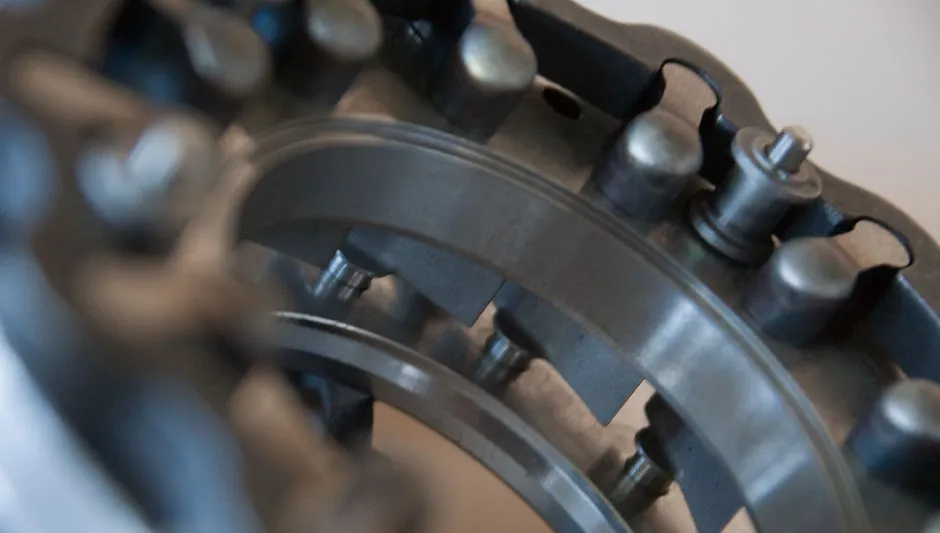
How a turbocharger works
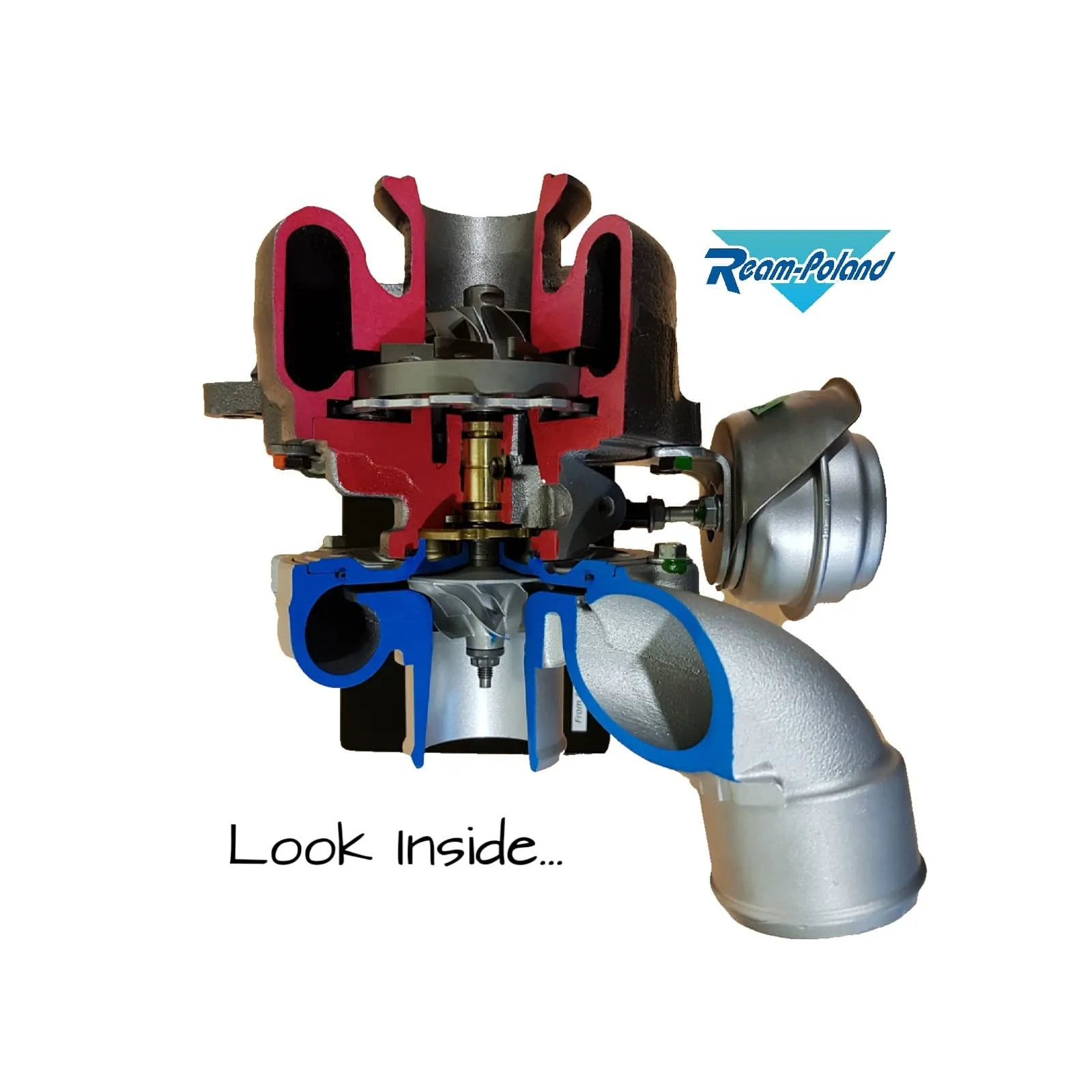
The name turbocharger comes from the permanently connected turbine and compressor assemblies. The turbine assembly consists of a wheel permanently joined to the shaft, with many specially profiled blades. The wheel sits in the turbine housing, which directs exhaust gas from the exhaust manifold onto the blades. The housing is closed by the rear wall of the centre housing, protected by a heat shield.
The compressor assembly consists of an aluminium compressor wheel in the compressor housing, closed by the front of the centre housing or the compressor back plate. This part compresses air and forces it at higher pressure into the engine’s intake manifold.
Exhaust gas is directed onto the turbine blades, where its energy is converted into torque and transmitted through the shaft to the compressor wheel. Because of high exhaust temperatures, turbine housings are usually cast iron, compressor housings and wheels aluminium, and turbine wheels and shafts high-grade alloy steel.
The shaft runs in the centre housing on journal bearings made of special bronze-based alloys, lubricated through oil galleries fed from the engine’s main oil gallery. In operation an oil wedge forms between the shaft and the bearing and between the bearing and the housing – allowing the turbocharger to run for long periods at speeds of up to 200,000 rpm. The oil also cools the bearings.
The centre housing is sealed by piston rings on the turbine and compressor sides, which keep oil out of the wheel sections. Because of the extreme operating conditions, turbocharger parts are made from special materials and balanced to high precision.
Work on a turbocharger by a garage that does not specialise in turbos often ends in damaged components and higher repair costs.
Turbocharger operating rules
Turbocharger life without repair when operated correctly (km).
- When starting a turbocharged engine for the first time, make sure the centre housing is filled with oil. Even a few seconds of running without proper lubrication significantly affects bearing life.
- Do not let oil pressure drop below 0.21 MPa. Insufficient oil raises bearing temperature, breaks the oil film and causes seizure.
- Never increase engine power, e.g. by raising the fuel dose above the permitted limit.
- Never run an engine with a faulty fuel system (e.g. leaking injectors). Excess fuel overheats the turbine and increases soot; poor atomisation deposits carbon on the blades – which can crack the turbine housing, seize the wheel or throw it out of balance.
- Strictly follow the manufacturer’s oil change intervals and oil quality and grade.
- Keep the intake air clean – dust abrades the compressor wheel and seals. Filters must be strong enough and must not restrict air flow.
Loss of power – what to check
Signs: poor acceleration, low power at full throttle, smoke.
| Check | Recommendation |
|---|---|
| Condition and cleanliness of the air filter | Replace if dirty or damaged |
| Injector pressure and spray pattern | Adjust or replace faulty nozzles |
| Engine condition | Check compression, tightness, valve clearance and timing |
| Tightness and patency of air, oil and exhaust lines | Clear, seal or replace defective lines |
| Injection pump operation | Check and adjust |
| Waste-gate valve operation | Check the opening point of the exhaust bypass valve (pressure actuator) |
| Turbocharger | Run a turbo test, check compressor inlet/outlet ducts, blade condition and shaft/wheel play |
Diagnosing a turbocharged engine by symptom
White smoke
- Deformed or blocked oil drain pipe Repair or replace the pipe
- Turbocharger component failure Repair the turbocharger
Loss of power
- Leaks in the exhaust manifold Check and seal
- Leaks in the intake manifold Check and seal
- Dirty air filter Clean or replace
- Dirty or damaged turbine Clean or repair
Noise and vibration
- Foreign objects contacting the wheel Check the intake/exhaust system and repair the turbo
- Play in the journal bearings Repair the turbocharger
- Unbalanced wheels Balance the shaft and wheel
Turbocharger malfunction
- Carbon build-up on turbine parts Check the fuel system, repair the turbo, change the oil
- Turbocharger seal leakage Check lubrication and air systems, repair the turbo
- Drop in boost pressure Check the air filter and intake/exhaust tightness; repair the turbocharger
Black smoke – restricted air supply
- Dirty air filter Clean or replace the filter
- Blocked air intake Clear the blockage
- Manifold leak Check connections, fix leaks
Black smoke – turbine does not rotate freely
- Contaminated oil Change the oil and flush the lines
- Scored journal bearings Turbocharger repair
- Cracked or kinked oil feed pipe Replace the pipe
- Very high oil temperature Change the oil grade
- Out-of-balance wheels Balance the turbo (remanufacture)
- Engine not warmed up before full revs Instruct the driver on correct turbo engine operation
- Turbine or compressor wheel rubbing the housing Turbocharger repair
- Bent turbine shaft Turbocharger repair
- Elevated exhaust temperature Adjust the engine
- Foreign objects Turbocharger repair
Black smoke – exhaust back-pressure
- Exhaust manifold leak (low wheel speed) Check and fix the leak
- Exhaust system restricted, deformed or blocked Clear the system or replace damaged parts
Beware of “pseudo-remanufacturing”
Many companies and individuals sell used or “remanufactured” turbochargers without proper equipment. Units from crashed cars are washed, sometimes the rings are replaced – without checking whether the remaining parts are within the manufacturer’s tolerances and without balancing. Such units often last only a few thousand kilometres.
Balancing the rotating assembly is fundamental to correct turbocharger operation. Modern variable-geometry turbochargers must never be fitted without balancing on a high-speed balancer – the consequences can be serious, including engine damage.
Another common practice is replacing the whole core assembly with a new one, often of doubtful quality and unknown origin – because it is faster and cheaper. Such turbochargers last 30–50 thousand km instead of 150–200 thousand km.
A turbocharger remanufactured correctly, to the manufacturer’s procedure, performs like a new one. That is why every remanufactured turbocharger should come with a certificate and warranty card stating who did the work and how it was balanced.
If you buy a replacement turbocharger, have the old one inspected by a turbo specialist. Finding the root cause costs little and prevents a repeat failure.